
Leather to pools

It was in 1932, in the middle of the Great Depression, that Coleco's story began. Maurice Greenberg, a Russian immigrant, sold leather and shoe repair supplies to shoe repairers through his Connecticut Leather Company in Hartford, Connecticut, the company that would later shorten its name to Coleco. His elder son, Leonard, had a knack for engineering and set up his own workshop in the back of his father's shop.

In the 1940s Leonard talked his father into a new venture, leather crafts. At first Coleco sold spools of leather lacing for stitching, and its moccasin kits went on to win awards; in 1954 one was chosen as a Child Guidance "Prestige Toy". In the mid-1950s Leonard turned to vacuum-formed plastic, designing and building his own forming machines to make plastic toys and small wading pools. Above-ground pools followed a few years later.
The pools did so well that they outgrew the leather side of the business. In 1961 the Greenbergs sold the leather and shoe-supply business and the company became Coleco Industries, Inc.

Going public and Coleco Canada
Coleco went public in 1962, offering 120,000 shares at $5 each. In 1963 it bought the Kestral Corporation, a maker of inflatable vinyl pools, and became the world's largest maker of above-ground swimming pools.

In 1966 Maurice's younger son, Arnold, joined Coleco as its chief legal counsel; he later became its president and chief executive. The same year Coleco bought Playtime Products, and in October 1968 it acquired Eagle Toys of Canada, a maker of tabletop hockey games, which later became Coleco Canada. (Read the story of its Montreal home on our Coleco Canada page.) In 1971 Coleco was listed on the New York Stock Exchange.
Telstar and the dock strike
In 1976 Coleco entered electronic games with the Telstar, a home Pong-style game that launched at $70 ($80 for the Telstar Classic) and was soon selling for around $50. It was built around General Instrument's AY-3-8500 "Pong-on-a-chip", and Coleco was one of the first companies to order it. About one million of the original Telstar were sold, and Coleco went on to release fourteen Telstar variants. The Telstar was a perfect product to keep the factories busy, and it sold well in 1977.
Coleco lost $22.3 million in 1978.
ColecoVision.dk, Coleco history
Then the luck turned. A shortage of chips and an East Coast dock strike in the fall of 1977 kept games from reaching stores before Christmas, dedicated Pong consoles fell out of favor, and the company was left with a glut of unsold Telstar units. Coleco lost $22.3 million in 1978.
ColecoVision
Coleco came back to electronics with licensed arcade hits. Its battery-powered tabletop Mini-Arcades, starting with Pac-Man, Galaxian, Donkey Kong and Frogger, sold about three million units within a year, about half of them Pac-Man.

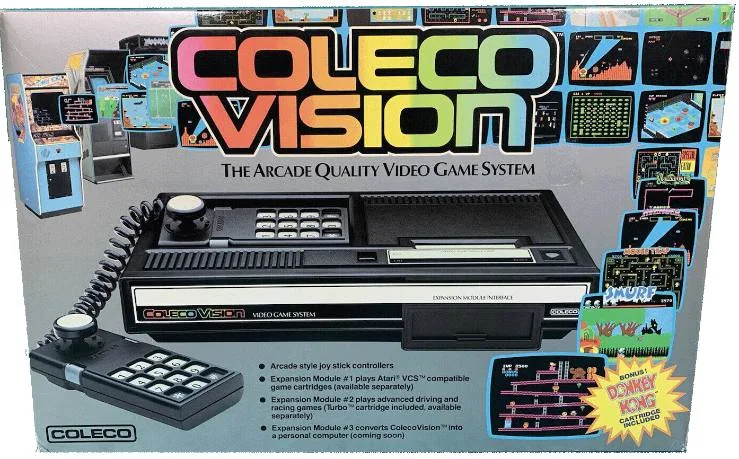
In 1981 Coleco began to study the market for video game systems again, and in August 1982 it introduced the ColecoVision, bundled with Donkey Kong. The arcade-quality system was an instant success: Coleco sold more than 500,000 consoles by Christmas and quickly became a serious challenger to Atari's 2600 and Mattel's Intellivision. Coleco also sold its games for those two rival systems, about eight million cartridges in all by early 1983.
Sales nearly tripled in a year: $178 million in 1981, $510 million in 1982.
Coleco annual report, 1982
Net earnings jumped from $7.7 million to $44.9 million, and Coleco's stock was one of the best performers on the New York Stock Exchange that year.
ADAM and the crash

Riding the ColecoVision craze, Coleco announced the ADAM home computer at the Summer Consumer Electronics Show in June 1983 and promised half a million by Christmas. The ADAM missed date after date; by December only about 95,000 had shipped, and many of them were defective. Sales for 1983 reached a record $596.5 million, but the costs and delays of the ADAM turned it into a $7.4 million loss.
At the same time the video game market collapsed. Home video game revenue in the United States fell from a peak of about $3.2 billion in 1983 to around $100 million in 1985. Coleco lost $79.8 million in 1984, and on January 2, 1985, it announced it was discontinuing the ADAM. The ColecoVision was dropped later in 1985.
A $79.8 million loss in 1984, on sales of $775 million.
Coleco annual report, 1985
Cabbage Patch Kids and the fall

One product kept Coleco going. Its Cabbage Patch Kids dolls, launched in 1983, became the toy craze of the decade, with shoppers fighting over them in stores. In 1985 Cabbage Patch Kids brought in about $600 million, more than three quarters of Coleco's sales, and the company earned a record $82.9 million on sales of $776 million.
The fad didn't last. In 1986 Cabbage Patch sales fell to about $250 million, and Coleco's total sales dropped to $500.7 million. Its attempt to diversify included buying Selchow & Righter, the maker of Scrabble and Parcheesi, for about $75 million, but Coleco lost about $111 million that year and another $105.4 million in 1987.
From a record $82.9 million profit in 1985 to two straight losses of more than $100 million.
In 1988 Coleco cut deeply into its remaining staff, and Arnold Greenberg resigned as chairman and chief executive. Unable to get a short-term line of credit, and in default on interest payments on $335 million of debt, Coleco filed for Chapter 11 bankruptcy protection on Tuesday, July 12, 1988.
The rise and fall, in numbers
Coleco's yearly results tell the story at a glance: the ColecoVision boom of 1982, the ADAM losses, the Cabbage Patch record of 1985 and the collapse that followed.
Show the numbers as a table
| Year | Net sales | Net earnings (loss) |
|---|---|---|
| 1980 | $162.9M | $16.6M |
| 1981 | $178.0M | $7.7M |
| 1982 | $510.4M | $44.9M |
| 1983 | $596.5M | −$7.4M |
| 1984 | $774.9M | −$79.8M |
| 1985 | $776.0M | $82.9M |
| 1986 | $500.7M | −$111.0M (about) |
| 1987 | $504.5M | −$105.4M |
Figures for 1980–1985 are from Coleco's annual reports. 1986 and 1987 are from news reports at the time; the 1986 loss is approximate.
Hasbro
In July 1988 Hasbro agreed to buy Coleco's children's furniture and tricycle lines for about $21 million, along with two Coleco plants in Amsterdam, New York. In July 1989 it completed its purchase of most of Coleco's remaining assets for about $85 million in cash. The deal included the Cabbage Patch Kids line, the Selchow & Righter board games and the right to use the Coleco name on toys. What was left of the company kept some real estate and cash for its creditors and had to adopt a new name.
The name lives on
In 2005 River West Brands revived the dormant Coleco trademark, and in 2006 it launched the Coleco Sonic handheld. In 2016 the brand was attached to the Coleco Chameleon, a planned cartridge console from the Retro VGS team that was to use leftover Atari Jaguar case molds. A prototype shown at the February 2016 Toy Fair in New York was found to contain an off-the-shelf Super Nintendo board, and a later "prototype" appeared to contain a video capture card. Coleco Holdings withdrew its name from the project in March 2016.
Sources: Coleco annual reports 1981–1985 (Internet Archive); UPI, January 1987, July 1988 and July 1989; Christian Science Monitor, July 1988; Wikipedia: Coleco, Coleco Adam, Coleco Telstar, Chameleon; Engadget; The Dot Eaters; ColecoVision.dk, Coleco history (the 1977 dock strike, the 1978 loss and the 1986 and 1987 losses).