Choose your path
BASIC: CVBasic
The easiest start. Built-in commands for sprites, sound and controllers; one source compiles for the ColecoVision, MSX, SG-1000 and more.
Get CVBasicC: SDCC
The free Z80 C compiler, with libcv/libcvu or the PVcollib SDK for graphics, sprites, sound and the F18A.
Get PVcollibAssembly: Z80
The traditional route and the most control. Tony Cruise's book teaches Z80 assembly for the ColecoVision and ADAM.
CV Tool KitThe limits at a glance
The hardware you are programming
A ColecoVision game runs on a Z80A CPU at about 3.58 MHz with only 1 KB of work RAM, a TMS9928A video chip with 16 KB of its own video RAM (256x192 pixels, 15 colors plus transparent, 32 sprites with a limit of four per line) and an SN76489 sound chip with three tone channels and a noise channel. Standard cartridges hold up to 32 KB; larger games use the MegaCart bank-switching scheme with 16 KB pages. The optional Super Game Module adds 24 KB of RAM that takes the place of the built-in 1 KB (up to 32 KB when it also covers the BIOS area) and an AY-3-8910 sound chip. The same video chip appears in the MSX, Sega SG-1000 and TI-99/4A, which is why so many tools and games move between those systems.
Languages and toolchains
CVBasic: written by Oscar Toledo Gutierrez (nanochess) and first released on 29 February 2024, CVBasic is an open-source BASIC cross-compiler with built-in commands for sprites, graphics, sound and controllers. It produces assembly that is assembled into a cartridge ROM, supports MegaCart bank switching up to 1 MB and can target the SGM with a command-line switch. The same source can also be compiled for MSX, SG-1000, TI-99/4A, NES and many other systems. Toledo's book Programming Games for Colecovision accompanies it. Because it is easy to learn, CVBasic has been behind a large share of recent releases.
Assembly: the traditional route. Tony Cruise's book Programming Games for the ColecoVision and Adam in Assembler teaches Z80 assembly specifically for the console, covering setup, game structure, graphics, collision and sound.
C with SDCC: the free Small Device C Compiler (maintained by Philipp Klaus Krause) targets the Z80. Krause also wrote libcv, a low-level hardware library, and libcvu, a set of convenience routines, which are LGPL-licensed and also support the SG-1000, Master System and MSX; his web tutorial walks through setting them up. PVcollib by Alekmaul is another free, MIT-licensed C library and SDK for SDCC, with routines for backgrounds, sprites, controllers and sound, plus F18A support; it builds on earlier work by newcoleco.
C with Z88DK: the long-running Z88DK development kit includes ColecoVision and ADAM targets, and AtariAge members have published tutorials on using it for both.
Earlier generations of homebrew were often written in C using the newcoleco (Daniel Bienvenu) development kit, built around an older commercial compiler, together with graphics tools from the same author; these are still referenced in forum threads and older tutorials.
Graphics, sound and music tools
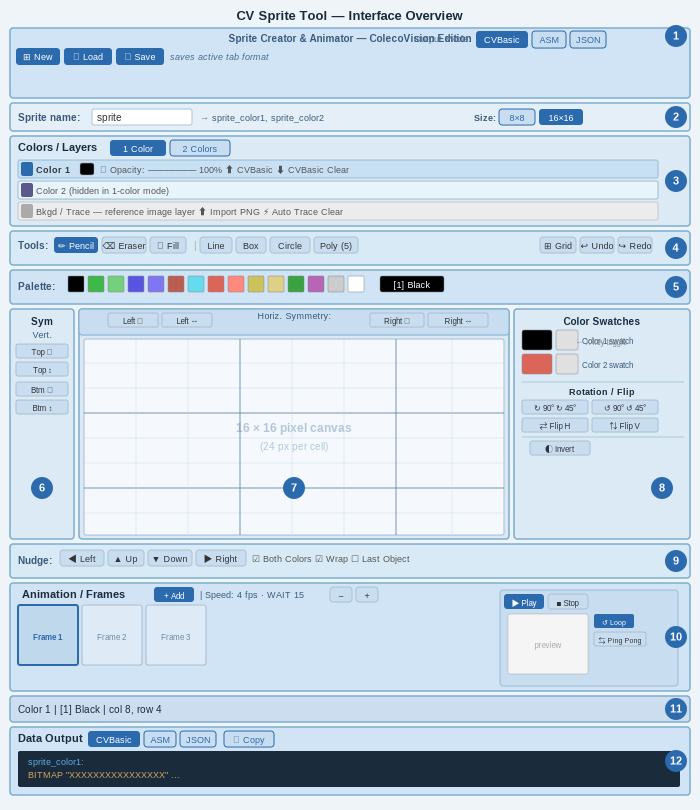
cvaddict's online CV Tool Kit contains four browser-based utilities: a 16x16 sprite editor with animation frames, a tileset and screen editor for the 256-tile graphics mode, a sound-effect designer for the SN76489 with presets, and a four-channel music tracker. Their output can be used directly with CVBasic or assembly.
Magellan, a map and tile editor originally written by Howard Kistler for the TI-99/4A and now maintained by Rasmus Moustgaard, edits tiles, sprites and maps for the TMS9918 family of video chips (including F18A color modes) and is used by some ColecoVision developers because the graphics hardware is shared.
Philipp Krause also provides PNG-to-ColecoVision graphics converters and compression tools alongside libcv. Emulators with debuggers, notably CoolCV and Gearcoleco, are essential for tracking down bugs.
Testing on real hardware
Emulators are convenient, but games should always be checked on a real console before release. Flash carts make this easy: the AtariMax Ultimate SD supports standard and MegaCart images, the BackBit Pro does the same with an adapter, and the low-cost PiCOLECO handles 32 KB images. The CollectorVision Phoenix is useful for testing SGM and F18A features without a modified console, but test on an original ColecoVision too.
Making physical cartridges
cvaddict documents open-source cartridge boards by Eric Chartre that can be ordered from PCBWay. The 32 KB board needs only a 74LS21 logic chip and a 27C256 EPROM or SST27SF256 EEPROM. The MegaCart board (128 KB to 512 KB) adds a GAL20V8 programmable logic chip and an SST39SF-series flash chip sized to the ROM, plus a few resistors and a capacitor. You will need an EPROM/EEPROM programmer and, for the GAL, the supplied logic file.
For shells, 3D-printable ColecoVision cartridge cases are available on Thingiverse from several designers. Commercial publishers generally use custom-molded shells, printed labels, boxes and manuals.
How homebrew gets published
Most developers either sell through an established boutique publisher, sell themselves, or release the ROM online, often free or pay-what-you-want. The main labels and outlets include:
| Publisher / outlet | Based | Notes |
|---|---|---|
| CollectorVision | Canada | Founded in 2008 by Jean-Francois Dupuis; publishes homebrew such as Bomb'n Blast and Ghost'n Zombies, SG-1000 conversions and prototypes; also makes the Phoenix console. |
| Team Pixelboy | Canada | Founded in 2009 by Luc Miron; the most prolific label, with many original games, MSX and SG-1000 ports and completed prototypes. |
| Opcode Games | USA / Brazil team | Eduardo Mello's label, started in 2002–03 (sources differ); creator of the SGM and SGC; known for arcade-accurate SGM ports. |
| 8-bit Milli Games | - | Publishes ColecoVision titles such as Runaway Train, Turmoil 2022, Arkadion, Qyxar and Virix, alongside games for other classic consoles. |
| Cote Gamers | France | Retro shop that publishes and sells ColecoVision cartridges, including 'Premium' editions of several homebrews; has sponsored the MSXdev contest. |
| Electric Dreams | - | Independent studio releasing CVBasic-built ColecoVision games (e.g., TAZ, CrackPots, Manhole) on itch.io, typically pay-what-you-want. |
| Inufuto | Japan | Developer who has released two dozen or so small original games for the ColecoVision and other systems as free ROM downloads. |
| itch.io and developer sites | - | Many authors, including Oscar Toledo, distribute ROMs directly; some also sell cartridges. |
Communities, events and contests
AtariAge's ColecoVision/Adam and ColecoVision Programming forums are the center of the scene, where tools are announced, code is shared and new releases are discussed. cvaddict.com catalogs homebrew releases and publishers.
ADAMcon, the annual Coleco ADAM convention, ran every year from 1989 to 2018 (ADAMcon 30) and remains a meeting point for ADAM and ColecoVision developers; the ADAM community continues with regular online meetups and occasional in-person events.
Because the ColecoVision shares its video and sound chips with the MSX, events such as the Barcelona MSX Users' Meeting and the MSXdev competition have overlapped with the ColecoVision scene: games are frequently ported between the two, and ColecoVision cartridges have been offered as prizes.
Homebrew milestones
- 1996
ColEm
Marat Fayzullin's emulator makes the ColecoVision playable on computers.
- Mid-1990s
The first homebrew
Kevin Horton's Kevtris (1996) is one of the first new ColecoVision games.
- 2002–03
Opcode Games
Eduardo Mello's label starts publishing arcade-accurate games.
- 2008–09
CollectorVision and Team Pixelboy
Two Canadian labels begin releasing boxed cartridges.
- 2012
SGM and F18A
More memory and sound, and VGA video, open the door to bigger games.
- 2019
Phoenix
CollectorVision's FPGA console plays it all on a modern TV.
- 2024
CVBasic
Oscar Toledo's BASIC compiler brings a new wave of developers.
See it built
Oscar Toledo (nanochess) builds a working ColecoVision on a breadboard.