
SpliceVision - Brazilian ColecoVision Clone
SYSTEM OVERVIEW
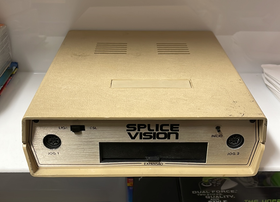
The SpliceVision is an extremely rare Brazilian clone of the ColecoVision, manufactured by Splice do Brasil — a professional telephony equipment company headquartered in Votorantim (near Sorocaba), in the interior of São Paulo state. It is a product of Brazil’s “Reserva de Mercado” (Market Reserve) policy of the 1980s, which restricted foreign electronics imports and spawned a wave of domestically-produced clone consoles.
Launched in November 1983 with 15 pirated games, the SpliceVision was created through reverse engineering of the original ColecoVision hardware. It was the only known ColecoVision clone produced in Brazil (another attempt, the MicroDigital Onyx, was prototyped but never commercially released). The console was priced at 300,000 cruzeiros at launch — roughly equivalent to five Atari 2600 clones — making it significantly more expensive than competing Brazilian systems.
The SpliceVision’s design reflects its manufacturer’s telephony origins. The white, boxy plastic enclosure resembles a piece of industrial equipment more than a consumer entertainment product. The controllers use round DIN connectors instead of the ColecoVision’s DB-9 ports — cheaper and more available in Brazil, but incompatible with any original ColecoVision accessories. Game titles were renamed with Portuguese-language alternatives: Donkey Kong became “Monkey Dong,” Zaxxon became “Jaxxon,” Venture became “Aventura,” and Pac-Man became “Ratoeira” (Mousetrap).
The console was discontinued by mid-1985 after a short production run. Today it is considered one of the rarest ColecoVision-related collectibles in the world, with complete units commanding prices of $1,000 or more.
🇧🇷Made in BrazilBuilt by Splice do Brasil in Votorantim, São Paulo. Born from Brazil’s Reserva de Mercado policy. 🔎Reverse EngineeredCreated through reverse engineering of the original ColecoVision hardware — the only Brazilian CV clone. 🎮23 Pirated Games15 launch titles + 8 added later. All renamed to Portuguese with modified artwork. 📞Telephony OriginsManufacturer Splice was a professional telephone equipment company — not a consumer electronics firm. 💰300K CruzeirosLaunch price equivalent to five Atari 2600 clones. Too expensive for the Brazilian market. ⭐Extremely RareOne of the rarest ColecoVision collectibles worldwide. Complete units sell for $1,000+.
TECHNICAL SPECIFICATIONS
| Manufacturer | Splice do Brasil (Votorantim, São Paulo, Brazil) |
| Type | ColecoVision clone console (reverse engineered) |
| Year | November 1983 (launched) — discontinued ~mid-1985 |
| Launch Price | 300,000 Cruzeiros (Dec 1983) |
| CPU | Zilog Z80A @ 3.58 MHz (8-bit) |
| Video Display Processor | Texas Instruments TMS9928A |
| Resolution | 256 × 192 pixels |
| Colors | 16 |
| Sprites | 32 total |
| Sound | Texas Instruments SN76489AN — 3 tone + 1 noise channel |
| RAM | 8 KB |
| VRAM | 16 KB |
| Controller Ports | 2 × DIN connector (round, NOT DB-9 — incompatible with original CV controllers) |
| Cartridge Slot | ColecoVision-compatible (uses larger proprietary cartridge shells) |
| Expansion Slot | Present but most original ColecoVision modules do not fit properly |
| Video Output | RF (adapted for Brazilian PAL-M television standard) |
| Boot Screen | “SpliceVision” in ColecoVision-style lettering and colors (replaces “ColecoVision”) |
| Construction | White rigid plastic hobby-kit style enclosure |
| Game Library | 23 pirated titles (15 launch + 8 added later) |
HARDWARE DETAILS & DIFFERENCES
What’s Similar to ColecoVision Same Z80A CPU, TMS9928A VDP, SN76489 sound chip ColecoVision-compatible cartridge slot (accepts CV cartridge PCBs) Expansion slot present on the console Cartridge entry mechanism with spring hatch Boot screen mimics ColecoVision style (same font/colors) What’s Different Round DIN controller connectors (not DB-9) Larger cartridge shells with different artwork White, boxy industrial plastic enclosure PAL-M video output for Brazilian TVs Expansion slot present but modules don’t fit right Boot screen reads “SpliceVision” instead of “ColecoVision” Controller Incompatibility The SpliceVision uses round DIN connectors for its controllers — a deliberate cost-saving choice, as DIN plugs were cheaper and more common in the Brazilian electronics market than DB-9 connectors. This means no original ColecoVision controllers or accessories work with the SpliceVision: no Roller Controller, no Super Action Controllers, no Driving Module. Only the SpliceVision’s own bundled controllers are compatible. Expansion Module Incompatibility Although the SpliceVision has an expansion slot that appears similar to the ColecoVision’s, most original Coleco modules do not fit properly. Either the on/off switch becomes inaccessible, or the controllers cannot be properly connected. The expansion slot is protected by a sliding mechanism cover.
GAME LIBRARY
Splice published a total of 23 pirated ColecoVision games with renamed titles, Portuguese-language adaptations, and redesigned cartridge artwork. The cartridge shells are larger than standard ColecoVision cartridges and feature colorful original art. 15 titles were available at launch, with 8 more added shortly after.
Known Renamed Titles
Monkey Dong ← Donkey Kong Jaxxon ← Zaxxon Aventura ← Venture Ratoeira ← Pac-Man (Mousetrap) About the Pirated Games All 23 SpliceVision games were unlicensed copies of original ColecoVision titles, adapted for the Brazilian market under Brazil’s Reserva de Mercado policy. The titles were renamed — often with attempts at Portuguese translation or creative alternatives — and the cartridge labels featured completely new artwork distinct from the original Coleco designs. This was done partly to avoid obvious copyright conflicts, though the games themselves were functionally identical to the originals. The ColecoVision cartridge ROM chips required were expensive, which limited the library size and contributed to the console’s high price.
BRAZIL’S RESERVA DE MERCADO
The SpliceVision can only be understood in the context of Brazil’s “Reserva de Mercado” (Market Reserve) — a government policy enacted during the final years of the military dictatorship that restricted the importation of foreign electronic products to protect domestic industry.
This policy had a dramatic effect on Brazil’s video game market. Since consoles like the Atari 2600, ColecoVision, and later the NES could not be officially imported, Brazilian companies reverse-engineered them and produced domestic clones. The Atari 2600 market was flooded with clones — the Dactar, Dynacom MegaBoy, CCE Supergame, and many others. But the ColecoVision, with its more expensive memory chips and complex hardware, attracted far fewer clone attempts.
According to the Brazilian magazine Micro & Vídeo, a genuine imported ColecoVision would have cost the equivalent of five Atari 2600 consoles in Brazil, making it prohibitively expensive. When the occasional unit appeared, it was contraband, expensive, and required TV adaption for the Brazilian PAL-M standard. This is the gap that Splice attempted to fill — but even the SpliceVision at 300,000 cruzeiros was too expensive to compete with the cheap Atari clones that dominated the market.
HISTORY & TIMELINE
Early 1980sBrazil’s Reserva de Mercado policy restricts foreign electronics imports. Domestic clone console industry emerges, dominated by Atari 2600 clones. 1982ColecoVision launches in North America. In Brazil, genuine units are extremely expensive contraband requiring PAL-M TV adaptation. 1983MicroDigital announces the Onyx, a ColecoVision clone, at the Feira Internacional de Informática do Anhembi in São Paulo. It is prototyped but never commercially released — MicroDigital pivots to the Onyx Junior, an Atari 2600 clone instead. 1983Splice do Brasil, a telephony equipment company in Votorantim (São Paulo), begins reverse-engineering ColecoVision hardware after a company partner learns about the console from a friend who traveled internationally. November 1983SpliceVision officially launches with 15 pirated games. Priced at 300,000 cruzeiros in December 1983. The boot screen displays “SpliceVision” in ColecoVision-style lettering. 1984Splice adds 8 more titles to the library, bringing the total to 23 games. The system struggles commercially against much cheaper Atari 2600 clones. ColecoVision cartridge ROM chips are expensive, keeping game and system prices high. Mid-1985SpliceVision is discontinued after a short production run. Splice returns focus to telephony equipment. Very few units survive. PresentThe SpliceVision is one of the rarest ColecoVision-related items in the world. Complete working units sell for $1,000+ among collectors. YouTube documentaries and Brazilian gaming historians have helped preserve its story.
THE ONYX CONNECTION
The SpliceVision was not the only attempt to bring the ColecoVision to Brazil. MicroDigital Eletrônica Ltda., also based in São Paulo, developed a ColecoVision clone called the Onyx. It was announced at the Feira Internacional de Informática do Anhembi in 1983 and was advertised in popular Brazilian magazines of the era.
However, MicroDigital determined that the expensive ROM chips required for ColecoVision cartridges made the product economically unviable for the Brazilian market. They abandoned the Onyx project and instead released the Onyx Junior — repurposing the Onyx casing and joystick design for an Atari 2600 clone. The Onyx Junior holds the distinction of being the only Atari 2600 clone in the world with a pause button, though the feature was reportedly unreliable (the game would sometimes freeze and not resume from pause).
Only a handful of Onyx ColecoVision prototypes are known to exist, making them even rarer than the SpliceVision. One working unit was eventually found and documented by Brazilian collector Marcus Garret. The Onyx was reportedly more refined in design than the SpliceVision, but it never reached consumers.
COLLECTING & RARITY
Why It’s Rare Very short production run (Nov 1983 to ~mid-1985) Manufactured by a telephony company, not a consumer electronics firm Limited to the Brazilian domestic market only Too expensive to compete — low sales numbers No retail advertising or television marketing Fragile DIN controller connectors prone to failure Low build quality plastic enclosure Collector Notes Complete boxed units are virtually unobtainable Working console-only units sell for $1,000+ USD SpliceVision cartridges are collectible in their own right Cartridge art is unique and distinct from Coleco originals Rarely appears on international auction sites Brazilian collector community is the primary market Circuit schematic drawn by “Josafá” dated 08/05/1984 exists
RESOURCES & LINKS
COLECOVISIONZONE BOJOGÁ (PORTUGUESE) PRODDIGITAL POP COLECOVISION.DK ATARIAGE FORUM ← BACK TO CV CLONESColecoVision™ is a trademark of its respective owner. All product names and trademarks are property of their respective owners. Historical information compiled from multiple public sources for preservation and educational purposes. Source credit: ColecoVisionZone.com, Bojogá, Proddigital POP.
From the archived colecovisionadam.com (DiRoccoVision): original page.