
Bradford
- Publisher / maker
- Aaron Contorer
- Category
- ADAM Software
- Type
- Uncategorized
- Media
- Floppy Disk
- Platform
- ADAM
- Listed by
- DiRoccoVision (ColecoVisionADAM.com)
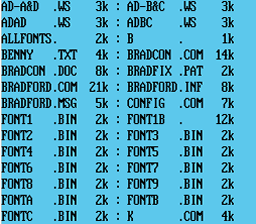
Bradford is a text formatting and printing utility developed in the 1980s by Aaron Contorer for enhancing output on dot-matrix printers, enabling near-letter-quality (NLQ) text production through graphics-mode rendering and multiple passes per line.[1] Designed primarily for CP/M operating systems, with later versions available for MS-DOS, it processes text files from various editors by interpreting embedded formatting commands to apply fonts, spacing, and styles.[1][2] The program supported a range of printers, including Epson FX/RX and MX models with Graftrax, Gemini 10/15X, and IBM dot-matrix printers, but was incompatible with Okidata models.[1] Key features included eight built-in fonts—such as Typewriter (with serifs), Modern (squared lines), and Vanilla (rounded sans-serif)—with options for mixing fonts on a page, adjustable character widths from 1/20th to 5/20ths of an inch, boldface in three intensities, underlining, italics, and support for proportional or fixed spacing.[1] Users embedded commands (similar to WordStar's, like ^B for bold or ^S for underline) directly in text files, with customizable command characters for compatibility across editors; additional capabilities encompassed margins, page numbering, line centering, full justification, and integration with graphics tools like PrintMaster.[1] Bradford operated interactively, prompting users through about 16 setup questions per run (e.g., printer type, file selection, font choice) without an installation process, and included a draft mode for faster printing alongside its slower NLQ mode (e.g., approximately 14 minutes for two pages on a Gemini 10X).[1] It came with Bradcon, a companion font-editing tool for customizing characters, and was distributed as public domain software with basic instructions, though a $15 manual was required for advanced features like multi-font lines.[1][2] Initially sold commercially by Contorer's firm, Concom Enterprises, for $39 plus shipping, it transitioned to shareware-like distribution, earning praise in 1980s computing newsletters for its versatility and affordability compared to daisy-wheel alternatives.[1] Limitations included no mid-setup cancellation, rough italics in larger sizes, and visible dots in curved fonts, but it handled errors gracefully without aborting prints.[1] Needs: CP/M
Sign in or join free to add this to your collection or wishlist.
Pictures & documents (1)
Screenshots · 1
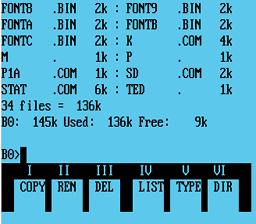
From the archives of colecovisionadam.com.